


Every quarter, we look at what is happening across the MYNDUP platform: what people are searching for, when they are booking support, and where the numbers are moving. Not to report for the sake of it, but because the patterns in how people seek help tend to show up in the data before they show up in your absence figures or exit interviews.
Here is what Q3 told us.
The topics that dominated Q3
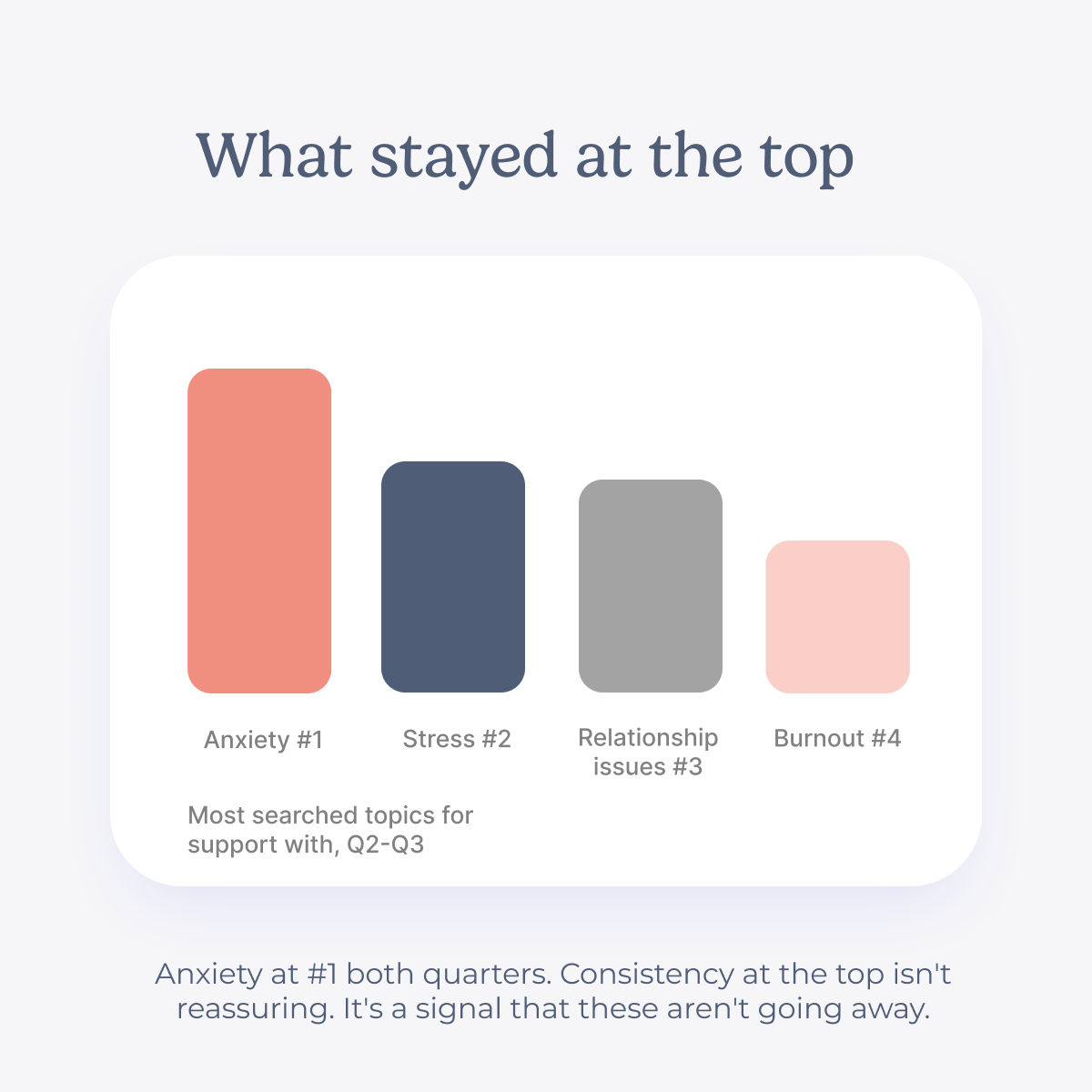
The four most searched topics for support across the platform this quarter were, in order: anxiety, stress, relationship issues and burnout (Source: MYNDUP platform data, 2026).
Anxiety held the top spot for the second quarter running. That kind of consistency is not reassuring. It is a signal that anxiety is not a seasonal spike or a response to a specific moment. It is a persistent, baseline experience for a significant number of working people. If your wellbeing provision treats it as an occasional issue, the data suggests it is something more structural than that.
Stress came in second, and the quarter-on-quarter movement here is worth noting. Searches around stress increased by 11% between August and September, a pattern that tracks closely with the return from summer leave and the shift back into full operational pressure. The September stress rebound is real, and it is predictable. Which means it is also preventable, with the right support timed correctly.
The one worth watching: depression
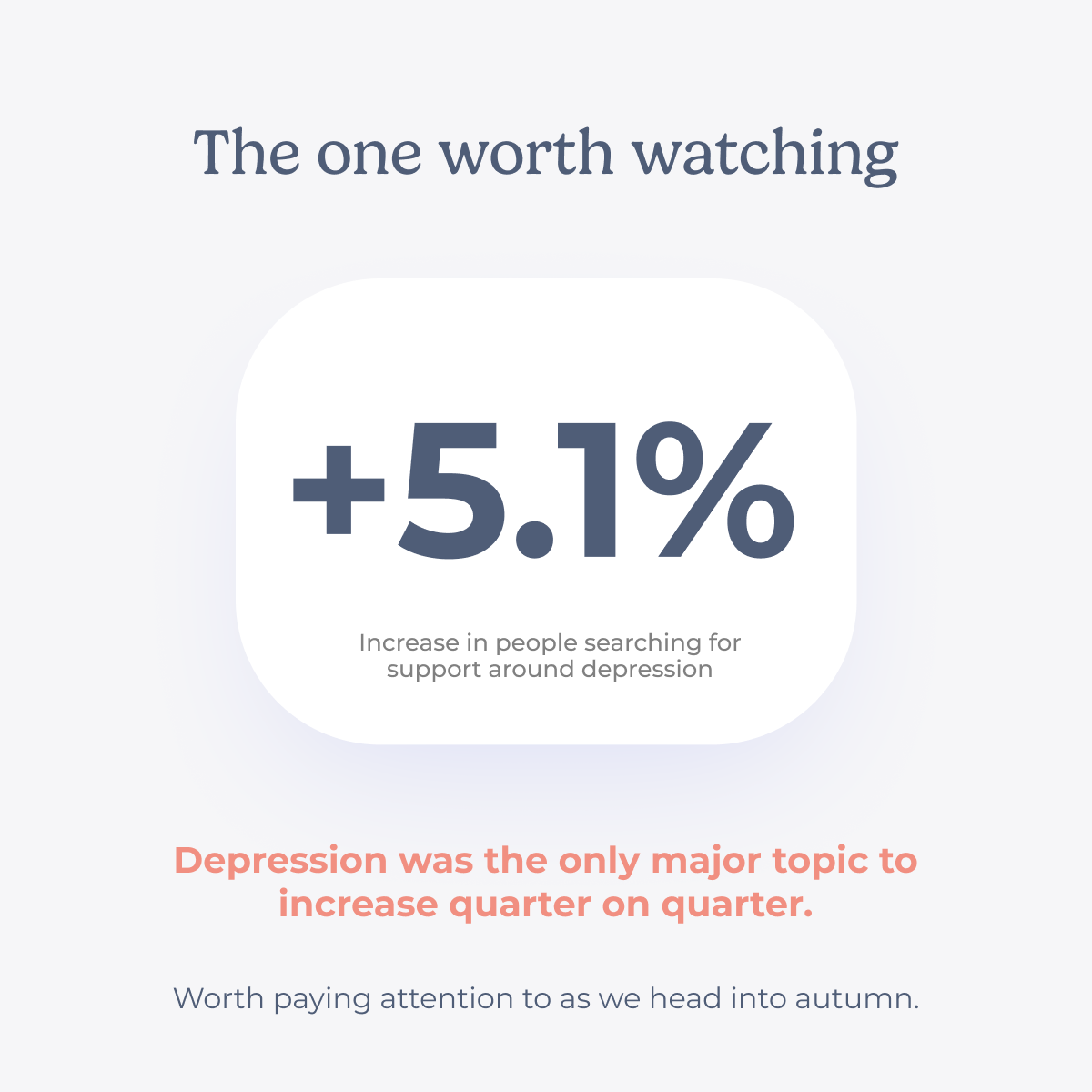
Depression was the only major topic to increase quarter on quarter, up 18% on Q2. That is a meaningful shift and one that warrants attention as we move into the final quarter of the year.
The autumn and winter months tend to be harder for people managing low mood, and the data from Q3 suggests those pressures are already building. If your organisation does not have proactive support in place for people before they reach crisis point, this is what the gap looks like in the numbers.
How people are getting support
Counselling and therapy remained the most accessed forms of support, accounting for 70% of bookings across the quarter. Life coaching and executive coaching made up the remaining 30%, with executive coaching specifically accounting for 11% of total bookings.
That last figure matters. Senior people are using this too. Wellbeing provision that is designed only for employees and not for the people leading them is missing a significant part of the picture, and potentially the part with the most organisational impact.
When people show up
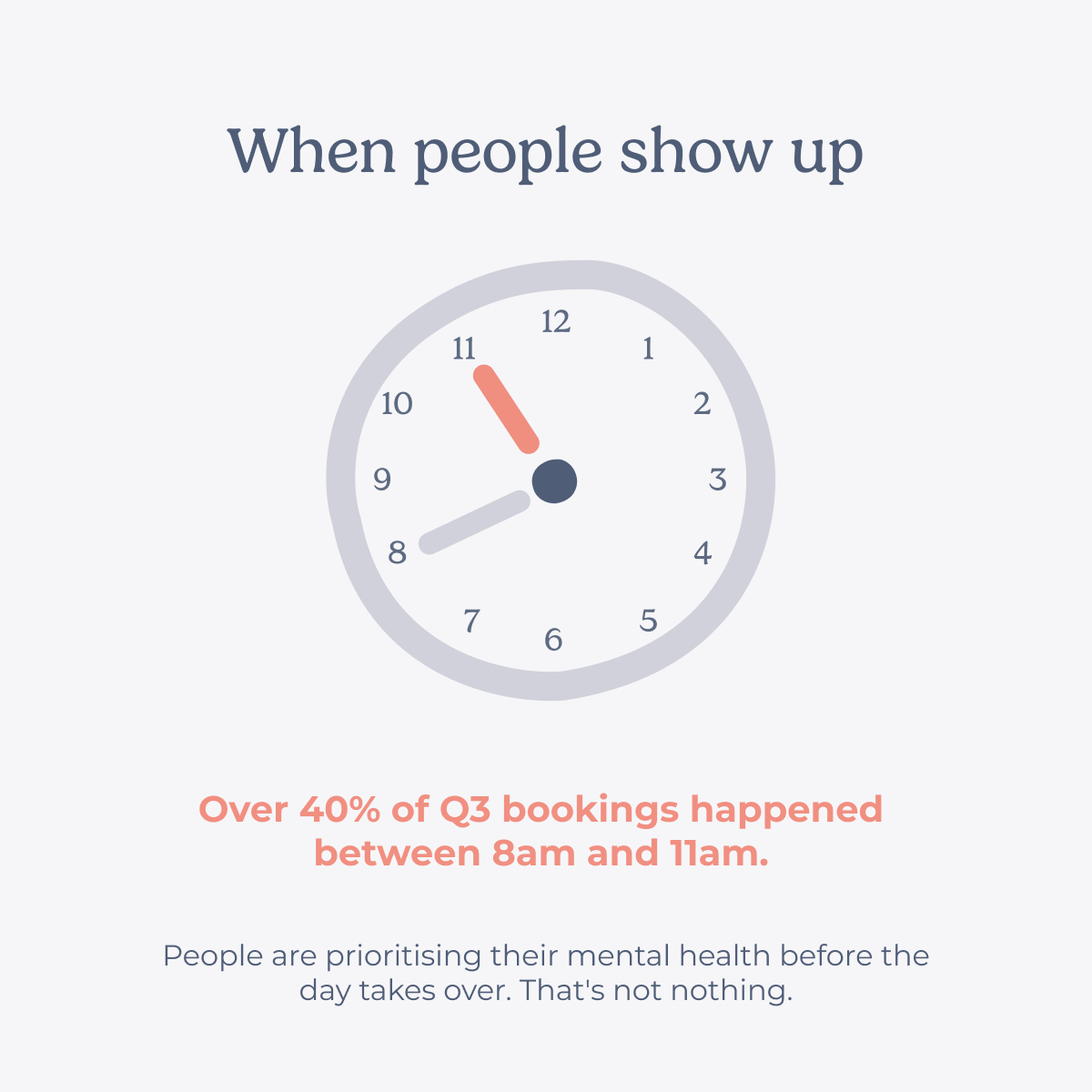
Over 40% of Q3 bookings happened between 8am and 11am.
People are prioritising their mental health before the day takes over. That is not a small detail. It tells you something about when your people are most motivated to seek support, and it raises a practical question worth sitting with: does your current wellbeing provision actually work at that time? Is it accessible before the diary fills up, or does it assume people will find a way to carve out time mid-afternoon?
Timing is not a soft consideration. It is an engagement driver.
What this means for your organisation
The Q3 data points to a few things worth acting on before Q4:
- Anxiety and stress are not going away. Provision that responds only when someone raises their hand is already behind. Proactive, accessible support that does not require a crisis to trigger it is what the data is asking for.
- Depression is rising. The autumn months tend to amplify this. Now is the right time to check whether your people have somewhere to go before things get heavy.
- Senior people need support too. If your wellbeing offering does not extend meaningfully to managers and leaders, you are supporting only part of the picture.
- Access timing matters. If your support is hard to reach before 9am or during a full working day, you may be losing the window when people are most ready to use it.
If you would like to talk through what this data means for your organisation specifically, we are happy to walk you through it.
FAQ
Where does this data come from?
This data comes from anonymised, aggregated activity across the MYNDUP platform. No individual data is identifiable. The figures reflect search and booking behaviour across our user base during Q3 2026.
What is the most common reason employees seek mental health support at work?
Across MYNDUP's platform, anxiety is consistently the most searched topic for support, followed by stress. Both have held their positions across multiple quarters, suggesting these are baseline experiences for many working people rather than seasonal spikes.
How can I use this data to inform our wellbeing strategy?
The most useful thing to do with this data is to hold it alongside your own. If your absence data, engagement scores or exit interview themes are pointing in the same direction, that convergence is a strong signal for where to focus your wellbeing investment.